How to Start Flying Lessons in Fort Worth, Texas: What to Expect from Day One
Published by:
Madison Barber
Published on:
Updated on:
Read time:
8 min read
If you are searching for flying lessons in Fort Worth, Texas, you might be wondering: What happens during the very first lesson? How much time do I spend in the air versus on the ground? Will I actually get to fly the airplane?
At Bird Dog Flight Services, our mission is to eliminate the intimidation factor from aviation. Operating out of Hicks Airfield (T67) in North Fort Worth, we provide structured, one-on-one instruction designed to build confidence from the moment you step into the hangar.
Here is a complete, step-by-step walkthrough of how to start flight lessons in Fort Worth, what you will experience during your first session, and how to set yourself up for efficient training.
Step 1: Begin with a Discovery Flight
Before committing to a full curriculum, almost every pilot starts with an introductory lesson known as a Discovery Flight.
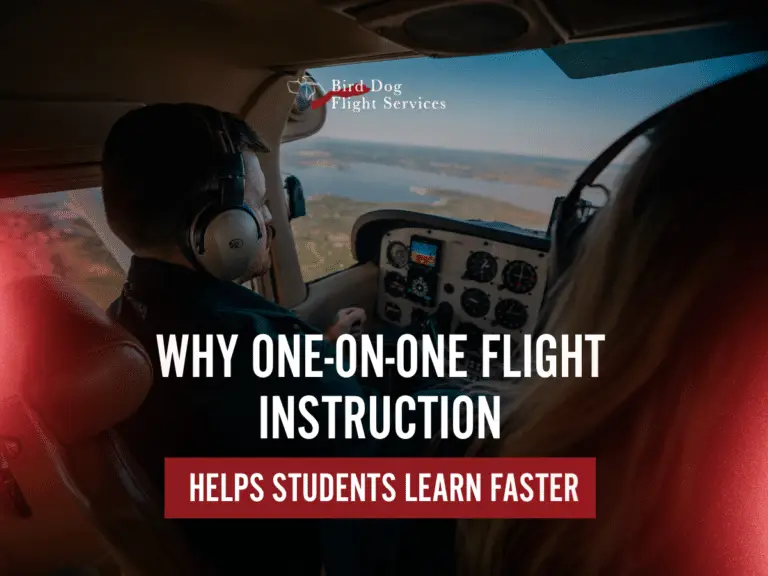
A discovery flight is not a passive sightseeing tour—it is an authentic introductory lesson where you sit in the left seat (the pilot-in-command seat), put on an aviation headset, and experience the flight controls under the guidance of an FAA-Certified Flight Instructor (CFI).
During a Fort Worth Discovery Flight:
- You will meet your dedicated instructor and discuss your personal goals (whether recreational flying or an airline career).
- You will walk through the pre-flight routine.
- You will fly for approximately 30 to 60 minutes over North Texas.
- You will log your very first hour in an official FAA pilot logbook.
If you enjoy the experience, those flight hours count directly toward your Private Pilot License (PPL).
Step 2: The Pre-Flight Briefing and Aircraft Walkaround
Every flight lesson begins on the ground with two critical steps: pre-flight briefing and the aircraft pre-flight inspection.
The Ground Briefing
Your instructor will explain the objectives for the flight. On your early lessons, the focus is on familiarization: how the controls work, the basic flight instruments (airspeed indicator, altimeter, attitude indicator, and turn coordinator), and proper safety protocols.
The Walkaround Inspection
Aviation safety begins on the ground. Before engine start, you and your instructor will walk around the training aircraft—such as our dependable Cessna 172 fleet—checking:
- Fuel quality and quantity: Sumping fuel samples to verify there is no water or sediment.
- Engine oil level: Ensuring proper lubrication before start-up.
- Control surfaces: Inspecting ailerons, elevator, and rudder for smooth and free movement.
- Propeller and airframe: Checking for any wear or irregularities.
- Pitot tube and static port: Ensuring airspeed and altitude sensors are clear.
Step 3: Engine Start, Taxiing, and Airspace Procedures
Starting the Engine
With checklists in hand, your instructor will guide you through starting the aircraft engine. You will monitor the oil pressure, turn on avionics, and check electrical systems.
Taxiing on the Ground
Pushing the left pedal turns the aircraft left; pushing the right pedal turns it right. Applying pressure to the top of the pedals engages the brakes. Within minutes of taxiing across the ramp, the foot steering becomes second nature.
Airspace Awareness in Fort Worth
One major advantage of training at Hicks Airfield (T67) is efficiency. Unlike towered regional airports where students frequently spend 15 to 30 minutes burning expensive fuel in long takeoff queues, Hicks lets you taxi smoothly to the runway and take off promptly. Yet, because we operate just minutes from Fort Worth Meacham (KFTW) and Dallas/Fort Worth International (DFW) airspace, you gain valuable experience communicating on aviation radios and navigating busy Class B, C, and D airspace environments.
Step 4: In the Air — The Four Fundamentals of Flight
Once airborne, you will climb away from the airport into the North Texas practice area. Here, your instructor will transfer the flight controls to you using the formal positive three-way exchange:
- Instructor: “You have the flight controls.”
- Student: “I have the flight controls.”
- Instructor: “You have the flight controls.”
Your early flying lessons in Fort Worth focus on the Four Fundamentals of Flight:
- Straight-and-Level Flight: Maintaining a constant altitude and heading by referencing the natural horizon outside the windscreen.
- Climbs: Adding power and pitching the aircraft nose up to gain altitude smoothly.
- Descents: Reducing throttle and trimming the aircraft for a steady, controlled descent.
- Turns: Coordinating the ailerons and rudder to bank the aircraft smoothly into shallow and medium turns.
You will quickly realize how responsive modern training aircraft are. Flight control inputs require gentle fingertip pressure rather than heavy muscle movements.
Step 5: Landing and Post-Flight Debriefing
After practicing basic maneuvers and enjoying aerial views of Fort Worth landmarks, Lake Worth, and the surrounding countryside, you will return to the airport pattern for landing.
Your instructor will guide you through:
- Setting up the traffic pattern (downwind, base, and final approach legs).
- Deploying flaps to manage airspeed and glidepath.
- Flaring smoothly for touchdown on the runway centerline.
The Debrief
After parking and shutting down the aircraft, you and your instructor will sit down for a thorough post-flight debrief. You will review what went well, identify areas to practice in the next session, and log the flight time. Your instructor will sign your logbook, officially recording your dual instruction hours.
What You Need to Know Before Starting
FAA Eligibility Requirements
To earn your Private Pilot License in the United States, the FAA requires:
- Minimum 16 years of age to solo, and 17 years of age to earn the certificate.
- The ability to read, speak, write, and understand the English language.
- An FAA Medical Certificate (Third-Class or higher) issued by an FAA-designated Aviation Medical Examiner (AME).
- A minimum of 40 flight hours (national average is between 55 and 70 hours for comprehensive proficiency).
Training at Your Own Pace
One of the core philosophies behind The Bird Dog Method is flexibility. You do not need to pause your career or quit your day job to learn to fly. We offer personalized scheduling seven days a week, allowing you to fly once a week, three times a week, or on accelerated full-time timelines.
Ready to Take the Controls?
Learning to fly is one of the most rewarding pursuits you will ever undertake. Whether your goal is weekend cross-country getaways with family or launching a career toward the commercial airlines, your journey begins with a single flight.
Explore our dedicated Fort Worth Flight Training Location Hub to discover available programs, check our transparent flight training pricing, or contact our team today to schedule your first lesson.
Next Steps for Future Fort Worth Pilots: